Stainless steel scrap (INOX) is a valuable secondary metallurgical raw material containing iron, chromium, nickel, molybdenum and other alloying elements. Its industrial value depends on chemical composition, steel grade, alloying element content and contamination levels.
According to European classification, stainless steels contain at least 10.5% chromium and no more than 1.2% carbon. Chromium enables the formation of a protective passive film that increases corrosion resistance.
Main groups of stainless steels
| Group | Alloying system | Magnetic properties | Applications |
|---|---|---|---|
| Austenitic | Fe–Cr–Ni, Fe–Cr–Ni–Mo | Usually weakly magnetic or non-magnetic | Tanks, pipes, food processing |
| Ferritic | Fe–Cr | Magnetic | Domestic appliances, exhaust systems |
| Martensitic | Fe–Cr–C | Magnetic | Knives, tools, machine components |
| Duplex | Fe–Cr–Ni–Mo–N | Magnetic | Chemical and marine equipment |
| Precipitation-hardening | Fe–Cr–Ni–Cu and others | Dependent on microstructure | High-strength engineering components |
Magnetic properties enable preliminary sorting but cannot uniquely identify a steel grade. Austenitic steels may acquire magnetic properties after cold deformation.
Common grades and chemical composition
Scrap classification uses American AISI designations and European EN material numbers. The table presents common grade correspondences and representative ranges of major alloying elements for the European grades.
| AISI / type | EN | Cr, % | Ni, % | Mo, % |
|---|---|---|---|---|
| 201 | 1.4372 | 16–18 | 3.5–5.5 | — |
| 304 | 1.4301 | 17.5–19.5 | 8–10.5 | — |
| 304L | 1.4307 | 17.5–19.5 | 8–10.5 | — |
| 316 | 1.4401 | 16.5–18.5 | 10–13 | 2–2.5 |
| 316L | 1.4404 | 16.5–18.5 | 10–13 | 2–2.5 |
| 321 | 1.4541 | 17–19 | 9–12 | — |
| 430 | 1.4016 | 16–18 | — | — |
| 410 | 1.4006 | 11.5–13.5 | — | — |
| Duplex 2205 | 1.4462 | 21–23 | 4.5–6.5 | 2.5–3.5 |
AISI and EN designations are not always fully equivalent. A dash indicates the absence of a specified intentional alloying addition rather than guaranteed absence of the element. Accurate identification requires consideration of the complete chemical composition and applicable standard.
Valuable elements in stainless steel scrap
| Element | Function in the alloy | Recycling significance |
|---|---|---|
| Fe — iron | Metallic matrix | Bulk material of secondary steel |
| Cr — chromium | Corrosion resistance | Replacement of primary chromium-bearing materials |
| Ni — nickel | Austenite stabilisation | Valuable alloying component |
| Mo — molybdenum | Resistance to localised corrosion | Increased value of molybdenum-bearing grades |
| Mn — manganese | Alloying and austenite stabilisation | Considered in furnace charge preparation |
| Ti — titanium | Carbon stabilisation | Requires control during remelting |
| N — nitrogen | Increased strength and corrosion resistance | Controlled during refining |
High nickel and molybdenum content generally increases scrap value, although the final assessment depends on the overall consignment composition, contamination and requirements of the metallurgical plant.
Commercial types of stainless steel scrap
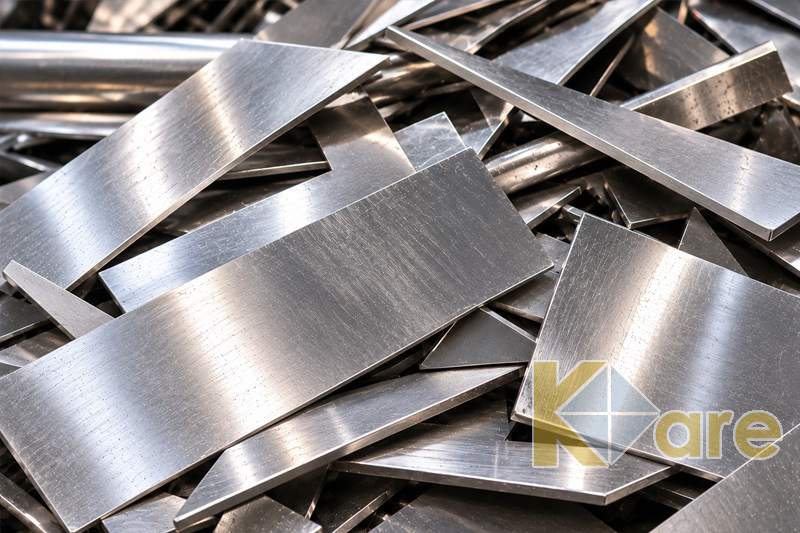
- Sheet offcuts, strips and production scrap.
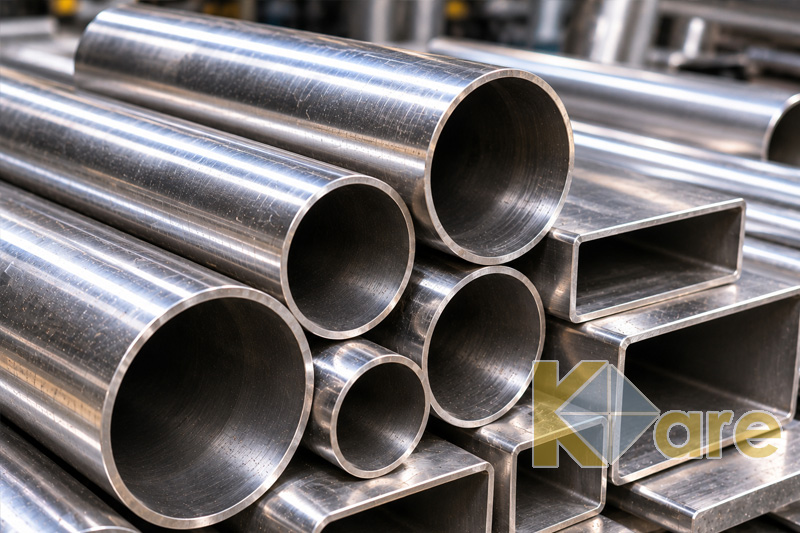
- Pipes, profiles, tanks and metal structures.
- Food processing and chemical industry equipment.
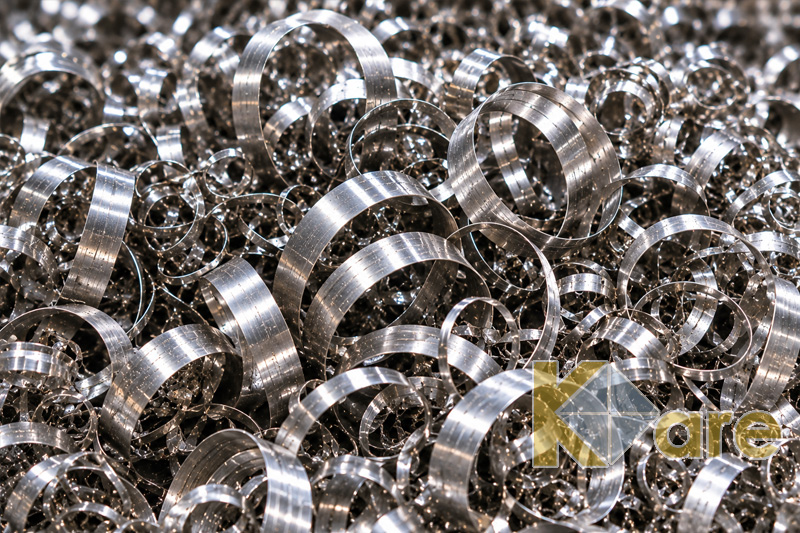
- Turning and milling swarf.
- Pump, valve and heat exchanger components.
- Mixed scrap with fasteners, coatings and foreign materials.
Homogeneous consignments with confirmed steel grades allow more accurate furnace charge calculations and reduce the need for corrective alloying additions.
Standards and identification methods
| Document or method | Purpose |
|---|---|
| EN 10088-1 | List and chemical composition of stainless steels |
| EN 10088-2 | Delivery conditions for sheet, plate and strip |
| EN 10088-3 | Delivery conditions for long products and semi-finished products |
| EN 10020 | Definition and classification of steel grades |
| EU Regulation No 333/2011 | End-of-waste criteria for certain types of metal scrap |
| XRF | Determination of Cr, Ni, Mo and other elements |
| OES | Chemical composition analysis, including carbon with appropriate calibration |
| LIBS | Instrumental alloy identification and sorting |
X-ray fluorescence analysis can distinguish many stainless steel grades, but conventional handheld XRF instruments cannot determine carbon content. Differentiating standard and low-carbon grades requires an appropriate analytical method.
Calculation of valuable metal content
The mass of an individual element in a homogeneous consignment is calculated from its mass fraction:
Here m is the mass of the metallic fraction and wE is the element content in percent. For example, 1000 kg of steel containing 17% chromium, 12% nickel and 2.2% molybdenum contains 170 kg Cr, 120 kg Ni and 22 kg Mo respectively.
The weighted average element concentration in a mixture of steel grades is calculated as follows:
The calculation uses the mass of metallic components excluding foreign materials. The resulting value represents the initial mixture before metallurgical losses.
Recovery and reuse of iron, chromium, nickel and molybdenum
The primary objective of stainless steel scrap recycling is to return valuable alloying elements to the metallurgical cycle. In conventional recycling, chromium, nickel and molybdenum are predominantly retained in the new alloy rather than extracted as chemically pure metals.
Raw material preparation and furnace charge formulation
Scrap is sorted by chemical composition, and foreign metals, polymers and service contamination are removed. Analytical results are used to formulate a furnace charge with the required iron, chromium, nickel and molybdenum content.
Electric arc furnace melting
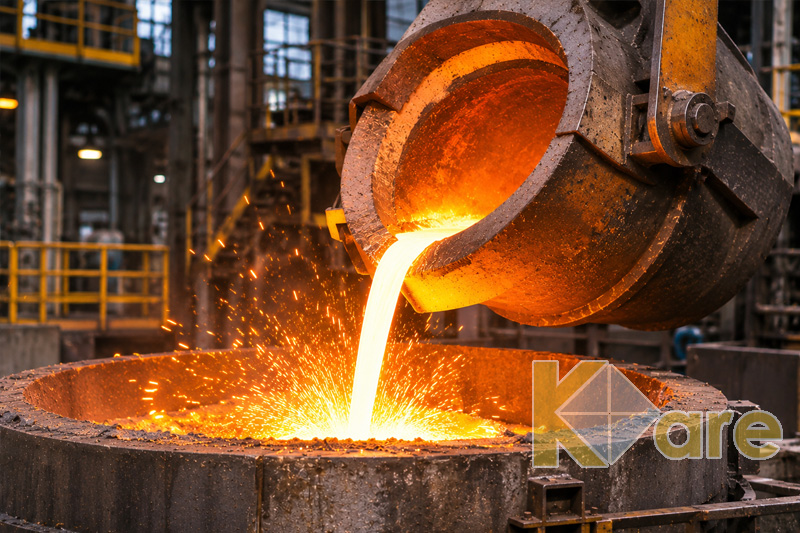
Prepared scrap is melted in an electric arc furnace. Iron and most of the nickel and molybdenum enter the metallic melt. Some chromium oxidises and enters the slag. Losses depend on charge composition and melting conditions.
AOD and VOD refining
Argon oxygen decarburisation (AOD) or vacuum oxygen decarburisation (VOD) reduces carbon content while limiting undesirable chromium oxidation. A simplified carbon removal reaction is:
Chromium oxide formed in the slag can be reduced using silicon, returning part of the chromium to the metallic phase:
After refining, the chemical composition is adjusted, necessary secondary metallurgy operations are performed and the steel is cast.
| Element | Behaviour during recycling | Final result |
|---|---|---|
| Fe | Predominantly enters the melt, partly oxidises | Matrix of new steel |
| Cr | Partly oxidises and is recovered from slag by reduction | Alloying component of new steel |
| Ni | Predominantly retained in the metallic phase | Nickel-bearing stainless steel |
| Mo | Predominantly retained in the melt under controlled conditions | Molybdenum-bearing steel |
| Mn and Si | Partly oxidise during refining | Residual content in steel and slag oxides |
Alloying element recovery efficiency
This coefficient represents the proportion of an element recovered in the target metallic product. Calculations must account for additional alloying materials and the complete material balance of the melt.
Specialised hydrometallurgical and combined processes can be used to recover individual metals from dust, slag and certain complex residues. However, the principal industrial recycling route for ordinary sorted stainless steel scrap remains the production of new alloyed steel.
Stainless steel scrap recycling enables the reuse of iron, chromium, nickel and molybdenum, reducing demand for primary metallurgical raw materials. Process efficiency depends on sorting accuracy, furnace charge composition and control of metallurgical losses.