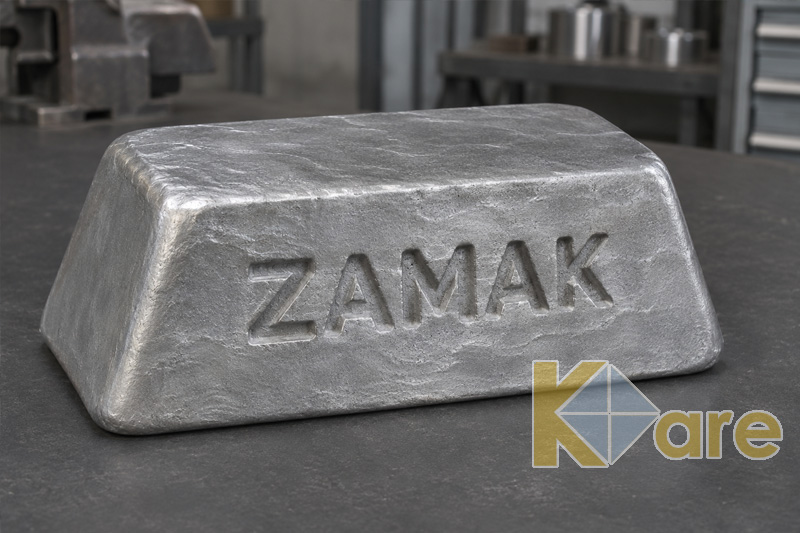
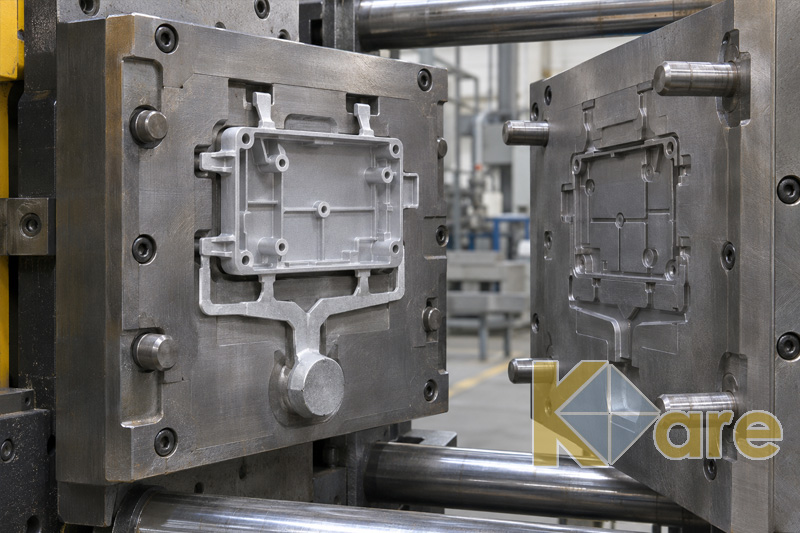
ZAMAK is a family of zinc-based alloys containing aluminium, copper and small magnesium additions. The name generally refers to zinc casting alloys containing approximately 4% aluminium. They enable accurate, complex components with high-quality surfaces, particularly through pressure die casting.
What is ZAMAK?
The name ZAMAK comes from the German names for zinc, aluminium, magnesium and copper. It identifies a material family rather than one universal grade.
The Russian abbreviation ЦАМ refers to a related group of zinc-aluminium-copper alloys. Grades covered by different standards must not automatically be treated as fully interchangeable: their chemical composition and casting requirements need to be checked.
The formula Zn + Al + Cu + Mg indicates the alloy system. Copper content varies considerably: it is restricted to a low level in ZAMAK 3, whereas it is a significant alloying addition in ZAMAK 5 and ZAMAK 2.
Chemical composition
| Element | Symbol | Role in the alloy |
|---|---|---|
| Zinc | Zn | Base metal |
| Aluminium | Al | Improves casting and mechanical properties |
| Copper | Cu | Increases strength and hardness, affecting ductility and dimensional stability |
| Magnesium | Mg | Small additions help limit impurity-related intergranular corrosion |
Common ZAMAK grades contain approximately 4% aluminium. Copper and magnesium contents are defined by the individual specification. High-purity zinc and strict limits on lead, cadmium and tin are particularly important.
Physical and mechanical properties
- Appearance: silvery-grey metal.
- Density: typically around 6.6–6.8 g/cm³ for common grades.
- Melting: occurs over a temperature range, approximately 380–390 °C depending on grade.
- Casting behaviour: good mould filling and reproduction of fine details.
- Strength and hardness: depend on composition and casting conditions.
- Ductility: varies between grades.
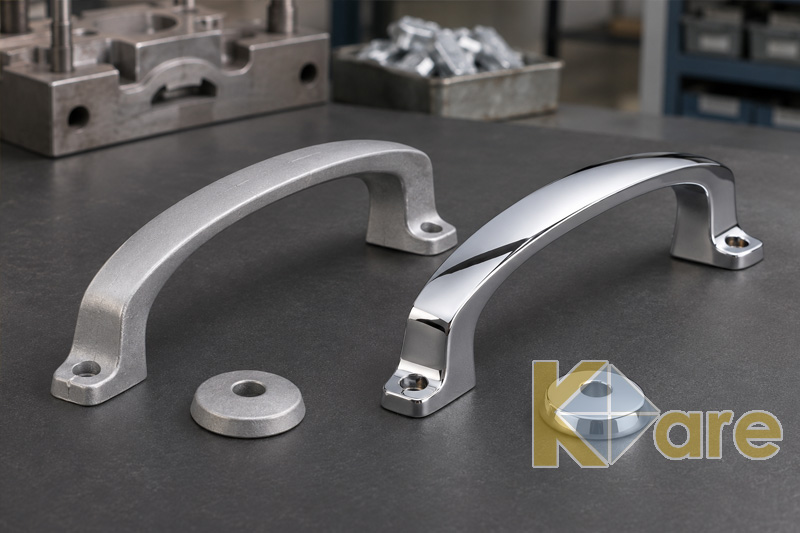
- Surface quality: supports decorative and protective finishes.
- Creep: must be considered under sustained loads and elevated temperatures.
The melting temperature is not the service temperature of a component. Permissible loads depend on temperature, service duration and design.
ZAMAK grades and European designations
| Grade | Casting designation under EN 12844 | Features |
|---|---|---|
| ZAMAK 3 | ZP3 | A general-purpose grade with low copper content and a balanced combination of properties |
| ZAMAK 5 | ZP5 | Approximately 1% copper; generally stronger and harder than ZAMAK 3 |
| ZAMAK 2 | ZP2 | Approximately 3% copper; greater hardness and strength, with particular attention to dimensional stability |
EN 1774 specifies zinc casting alloys in ingot and liquid form, while EN 12844 covers zinc alloy castings. ZL feedstock designations must be distinguished from ZP casting designations. The corresponding adopted LVS EN standards apply in Latvia.
An example of an ingot material designation is ZL0410 / ZnAl4Cu1 for ZAMAK 5. Final conformity is checked against supplier documentation and the applicable standard.
Casting and component manufacture
ZAMAK is widely used in hot-chamber pressure die casting. The process supports series production of thin-walled parts, ribs, locating features and decorative surfaces.
Quality depends on die design, filling conditions, temperature and air evacuation. Porosity, shrinkage defects and surface characteristics are considered during design and selection of subsequent processing.
Machining and joining
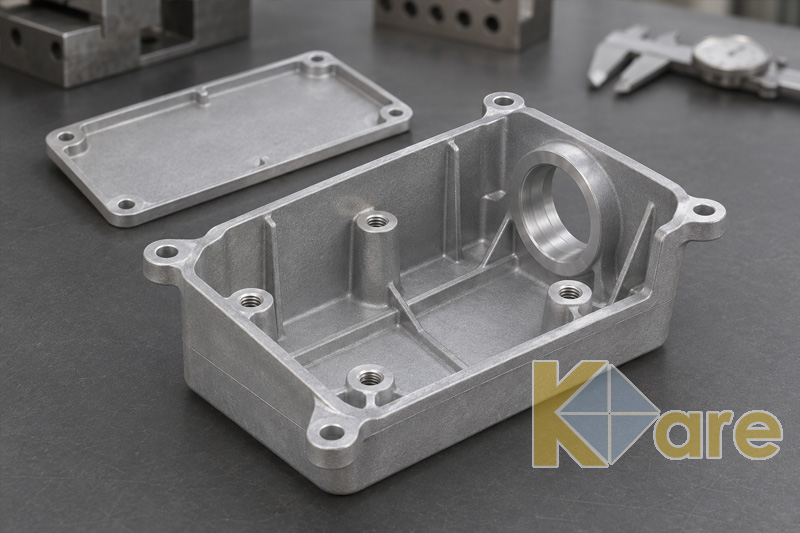
Castings can be drilled, milled and tapped where necessary. Near-net-shape manufacture reduces the amount of machining required.
Threaded joints, press fits, riveting and other suitable assembly methods are used. Conventional fusion welding should not be assumed to be a universal joining method for ZAMAK parts.
Coatings and corrosion resistance
Components may be painted, powder coated or electroplated. Surface preparation and coating layers are selected according to grade, casting condition and the required appearance.
In damp or aggressive environments, corrosion resistance is assessed for the complete product, including its coating and contact with other metals.
Ageing and dimensional stability
The properties of zinc castings can change with time. Natural ageing and temperature exposure may affect dimensions and mechanical performance.
Precision parts require consideration of the grade, post-casting conditioning and stabilisation requirements. No single heat-treatment schedule applies to all ZAMAK products.
Applications
- Furniture fittings: handles, fastening components and decorative parts.
- Locks and mechanisms: housings and locking-device components.
- Automotive components: small housings, brackets and decorative products.
- Electrical equipment: housings, connecting parts and shielding components.
- Consumer products: appliance parts, fasteners and accessories.
Comparison with other casting alloys
| Material | Base metal | Characteristic features |
|---|---|---|
| ZAMAK | Zinc | Accurate castings, good surface quality and comparatively high density |
| Silumin | Aluminium | Lower density, different casting conditions and service properties |
| Brass | Copper | Different composition, appearance and temperature characteristics |
The higher-aluminium ZA family should be distinguished from conventional ZAMAK grades. Similar appearance does not imply identical properties.
Advantages and limitations
ZAMAK offers casting accuracy, complex geometry, good surfaces and convenient decorative finishing. It is particularly attractive for series production of small components.
Limitations include density, creep, changes in properties with time and sensitivity to unwanted impurities. Grade selection considers loads, temperature, tolerances and service conditions.