Hastelloy (Ni + Mo + Cr) — composition, properties and applications
Hastelloy (Ni + Mo + Cr): composition and alloy characteristics
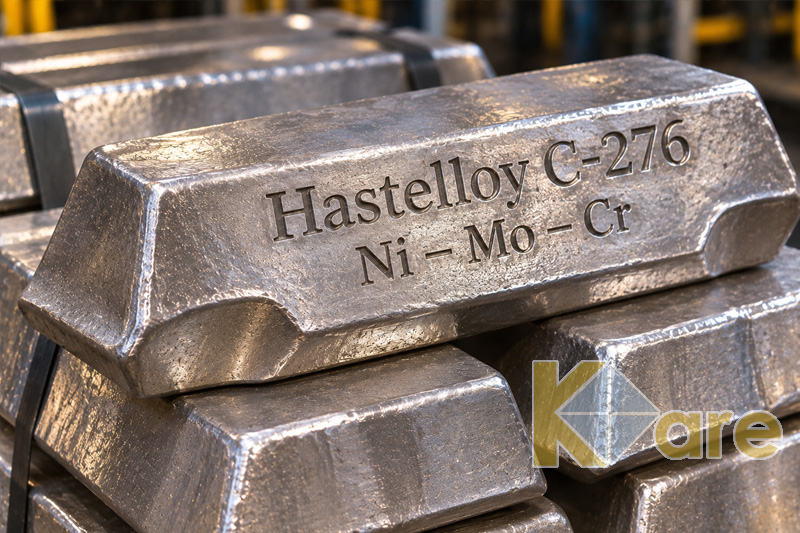
Hastelloy is a family of highly alloyed nickel-based materials developed for service in aggressive chemical environments. Well-known corrosion-resistant grades rely on a combination of nickel (Ni), molybdenum (Mo) and chromium (Cr). Depending on the grade, the composition may also include iron, tungsten, copper and other elements.
Nickel forms the alloy matrix and contributes to structural stability. Molybdenum improves resistance to localised corrosion and certain reducing environments, while chromium supports corrosion resistance under oxidising conditions. Together, these elements make the Hastelloy family suitable for demanding industrial processes.
The formula Ni + Mo + Cr identifies the principal elements of the alloy group discussed here rather than the exact chemical specification of every Hastelloy grade. Properties must always be assessed for the particular alloy.
Hastelloy grades and technical properties
Several Hastelloy grades are used in industry, offering different combinations of corrosion resistance, strength and manufacturing characteristics.
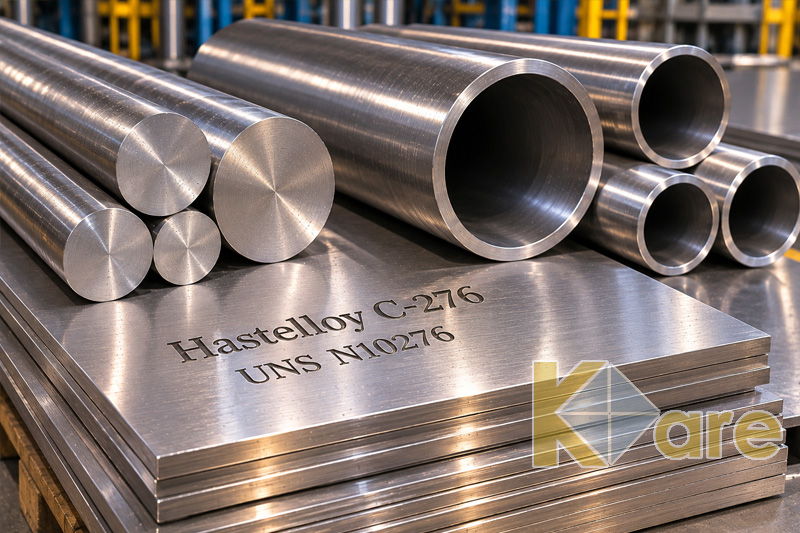
- Hastelloy C-276 (UNS N10276) — a nickel-molybdenum-chromium alloy containing iron and tungsten, recognised for resistance to a wide range of aggressive media.
- Hastelloy C-22 (UNS N06022) — a nickel alloy with relatively high chromium content, designed for a variety of oxidising and reducing environments.
- Hastelloy C-2000 (UNS N06200) — a nickel-chromium-molybdenum alloy with added copper to broaden performance in selected chemical environments.
Hastelloy C-276 has a density of approximately 8.89 g/cm³ and a melting range of roughly 1325–1370 °C. Mechanical properties depend on product form, delivery condition and service temperature.
C-family alloys offer good resistance to pitting and crevice corrosion and to stress-corrosion cracking in many environments. However, no alloy is universally resistant to every chemical: concentration, temperature and process conditions must be considered.
Manufacturing and industrial applications of Hastelloy
Hastelloy is supplied as sheets, plates, bars, tubes, wire, forgings and welded fabrications. Its combination of corrosion resistance and fabrication properties makes it useful for equipment requiring high reliability.
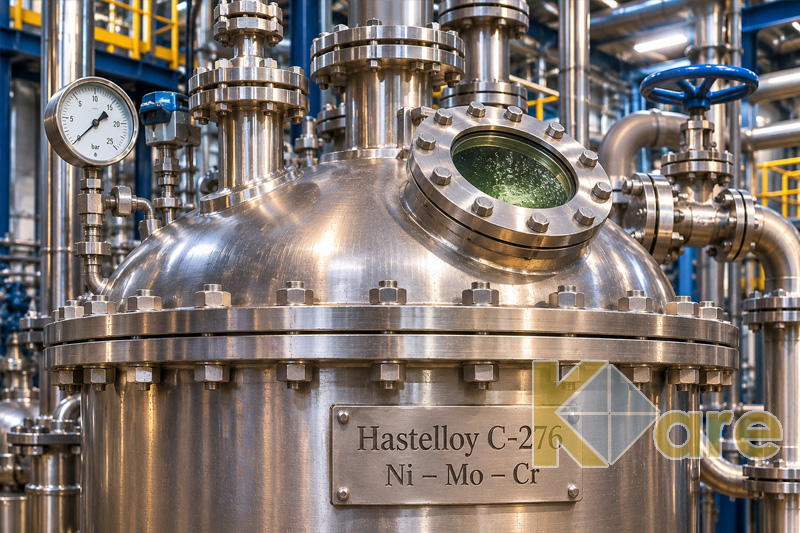
- Chemical processing — reactors, vessels, piping, pumps and valves exposed to aggressive process media.
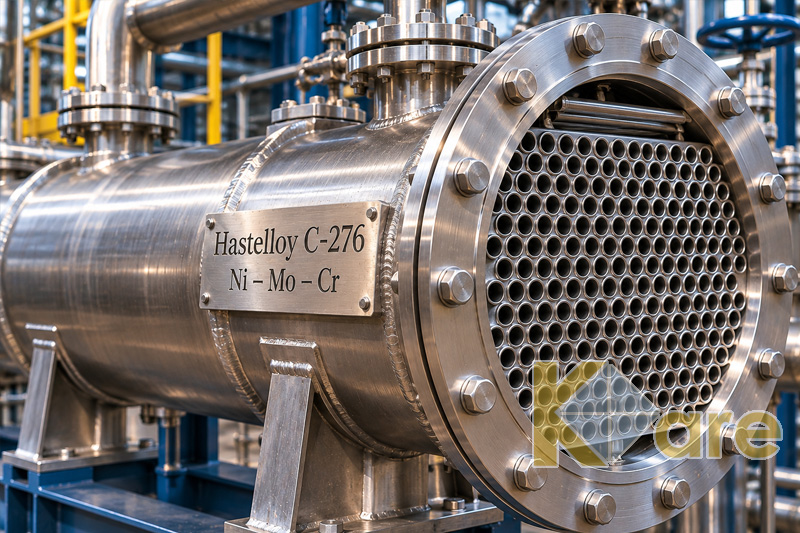
- Heat exchange equipment — tube systems and components in contact with corrosive fluids.
- Pharmaceutical manufacturing — selected process equipment components requiring high chemical resistance.
- Industrial gas treatment — components for gas cleaning and flue-gas desulphurisation systems.
- Power generation — specialised equipment parts exposed to combined thermal and corrosive conditions.
Hastelloy alloys can be welded and formed using suitable procedures. Machining may require special attention because these nickel alloys tend to work-harden.
European standards and material selection
Corrosion-resistant Hastelloy grades are identified by international UNS designations and European material numbers. For example, Hastelloy C-276 is UNS N10276 / Werkstoff 2.4819, while Hastelloy C-22 is UNS N06022 / Werkstoff 2.4602.
Nickel alloys are covered by applicable product-specific standards. EN 10095 concerns heat-resisting steels and nickel alloys, while EN 10204 defines types of inspection documents for metallic products. The relevance of each standard must be verified against the alloy's intended use and product form.
When selecting Hastelloy, engineers should consider chemical composition, corrosive environment, operating temperature, mechanical loads and welding requirements. Critical applications require verified manufacturer data and appropriate inspection documentation.
Kare Pluss presents Hastelloy in the Alloy Atlas as a family of highly alloyed nickel materials for chemical processing, power generation and industrial equipment operating in aggressive environments.