Tin-based Babbitt is an antifriction alloy consisting primarily of tin (Sn), with antimony (Sb) and copper (Cu) additions. It is chiefly used to form the working surfaces of plain bearings. A relatively soft tin matrix combined with hard structural constituents provides favourable conditions for lubricated sliding contact.
What is tin-based Babbitt?
Babbitt metals are a group of bearing alloys used to cast and manufacture antifriction surfaces. Tin-based Babbitt alloys are characterised by high tin content and alloying additions, primarily antimony and copper.
These materials operate against a harder shaft surface. Their purpose is to provide favourable sliding conditions in the presence of lubricant, reduce the risk of shaft damage and accommodate minor geometric deviations between mating components.
Tin-based Babbitt should not be confused with lead-based Babbitt. Both are antifriction alloys, but they differ in base metal, chemical composition and service characteristics.
Chemical composition of tin-based Babbitt
| Component | Symbol | Function |
|---|---|---|
| Tin | Sn | Forms the principal ductile metallic matrix |
| Antimony | Sb | Contributes to hard phases, increasing hardness and resistance to deformation |
| Copper | Cu | Forms strengthening intermetallic constituents and influences alloy microstructure |
Element proportions depend on the grade. Common tin-based Babbitt alloys generally contain approximately 80–90% tin, 7–13% antimony and 3–8% copper. These ranges are indicative and do not replace the specified composition of a particular grade.
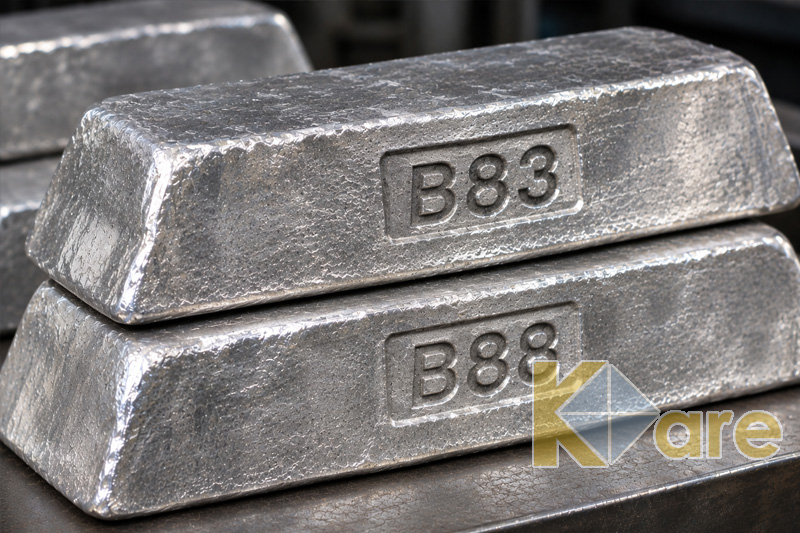
Well-known grades include B83 and B88. Their compositions and permitted impurities should be checked against applicable specifications and material certificates.
Microstructure and operating principle
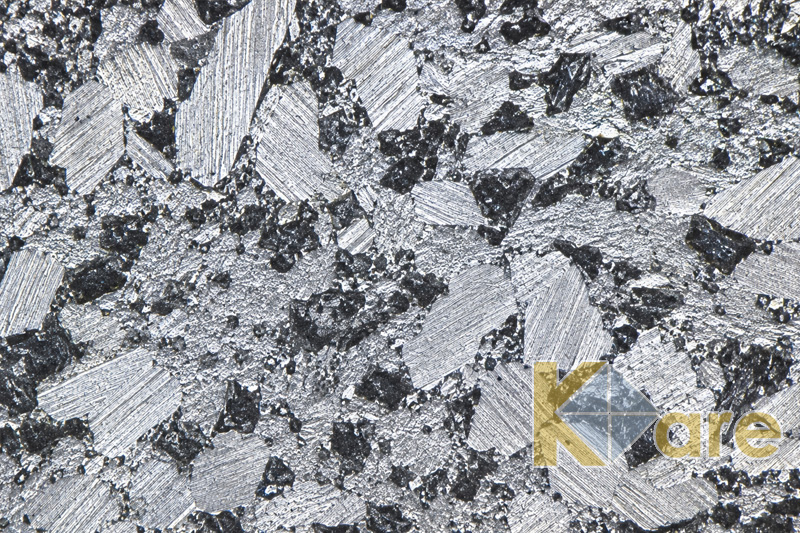
A characteristic feature of tin-based Babbitt is the combination of a relatively soft tin-rich matrix and harder structural constituents. The Sn–Sb–Cu system can contain intermetallic phases involving tin, antimony and copper.
Hard particles help support contact loads, while the more ductile matrix promotes conformability and the ability to embed small foreign particles, reducing the risk of shaft damage.
The size, shape and distribution of hard phases strongly influence performance. Therefore, chemical composition and the melting, casting and cooling processes are all important.
Physical and mechanical properties
- Appearance: silvery-white or silvery-grey metal.
- Density: typically around 7.3–7.5 g/cm³, depending on grade.
- Melting behaviour: the alloy has a melting range determined by its composition.
- Hardness: higher than pure tin because of alloying additions and hard phases.
- Antifriction properties: designed for lubricated sliding contacts.
- Conformability: allows the surface to accommodate small geometric deviations.
- Thermal conductivity: helps dissipate heat from the contact area.
- Fatigue resistance: depends on grade, microstructure, layer thickness and loading conditions.
- Corrosion resistance: depends on the environment, lubricant and alloy composition.
Bearing calculations require data for the specific grade, taking account of temperature, sliding speed, contact pressure and lubrication conditions.
Grades of tin-based Babbitt
| Grade | Main components | Characteristics |
|---|---|---|
| B83 | Sn + Sb + Cu | Common high-tin antifriction alloy |
| B88 | Sn + Sb + Cu | Tin-based Babbitt with different alloying-element proportions |
| Other grades | Sn + Sb + Cu and possible additions | Composition and applications are defined by the relevant standard or technical specification |
Grade selection depends on bearing service conditions. The designation Sn + Sb + Cu alone does not establish the exact composition or permissible loads.
Manufacturing and bearing lining
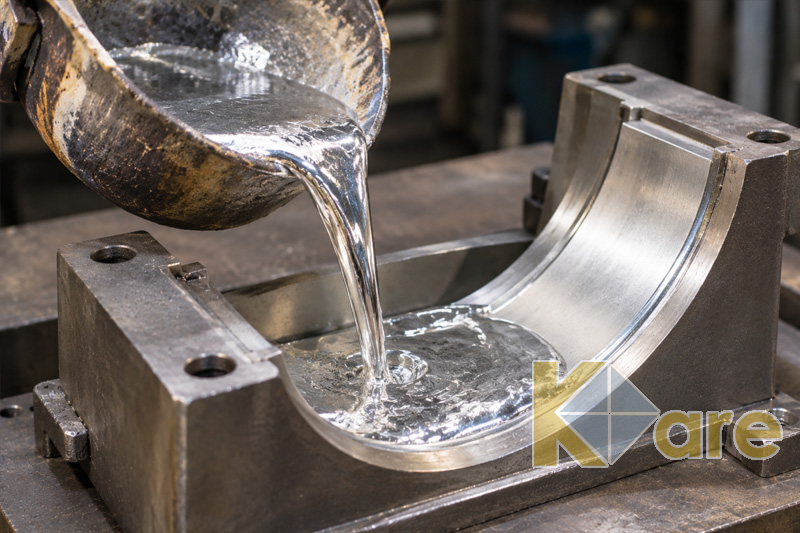
Tin-based Babbitt is produced by melting metal charge materials while controlling chemical composition, temperature and melt cleanliness. In bearing manufacture, the molten alloy is applied to a prepared metallic backing.
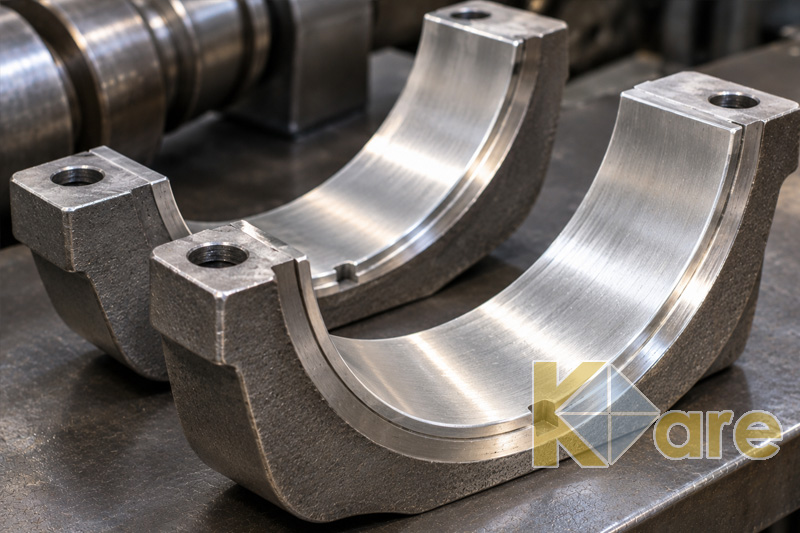
The bearing housing or shell may be made of steel, cast iron or another structural material. Babbitt forms a relatively thin working layer that interacts with the shaft through a lubricating film.
Bond quality between the Babbitt and backing, together with the absence of pores, cracks and contamination, is essential for bearing service life.
Machining and quality control
After casting, the working surface is machined to the required dimensions and geometry. Boring, turning and other operations are used according to the manufacturing procedure.
Inspection covers antifriction-layer thickness, surface condition, bonding to the backing, defects and chemical composition. Additional nondestructive testing may be required for critical equipment.
Applications of tin-based Babbitt
- Plain bearings: working layers of bearing shells and bushings.
- Turbomachinery: bearing assemblies designed for the relevant loads and speeds.
- Electrical machines: selected bearings in generators and large electric motors.
- Compressors and pumps: plain bearings in industrial equipment.
- Marine machinery: bearing surfaces in selected assemblies.
- Equipment repair: restoration of worn antifriction layers.
Specific applications depend on component design, lubrication system, temperature and equipment manufacturer requirements.
Comparison with other bearing materials
| Material | Base | Characteristics |
|---|---|---|
| Tin-based Babbitt | Sn + Sb + Cu | Good conformability and antifriction performance with appropriate lubrication |
| Lead-based Babbitt | Pb with alloying additions | Different composition and service characteristics |
| Bearing bronze | Cu with alloying elements | Higher strength in certain grades and different tribological requirements |
| Polymer bearing materials | Polymers and fillers | Suitable for specialised conditions, including some applications without liquid lubrication |
These materials are not universally interchangeable. Selection depends on load, speed, temperature, lubrication and bearing design.
Operating conditions and limitations
Tin-based Babbitt is primarily intended for properly lubricated operation. Lubrication failure may cause temperature rise, accelerated wear and damage to the antifriction layer.
The material has temperature and load-carrying limitations. Prolonged operation under unfavourable loads may result in deformation, fatigue damage or lining separation.
Permissible operating conditions depend not only on the alloy but also on bearing construction, lining thickness and heat dissipation.
Tin-based Babbitt scrap and recycling
Tin-based Babbitt is valuable secondary raw material because of its high tin content. Scrap includes old bearing shells, casting residues, runners, machining chips and other production waste.
During sorting, tin-based Babbitt must be distinguished from lead-based Babbitt, and the presence of steel or cast-iron backing must be considered. The total mass of a bearing is not the same as the mass of its Babbitt lining.
Instrumental methods, including X-ray fluorescence analysis, are used to identify composition. Secondary-material value depends on actual tin, antimony, copper and impurity contents, as well as acceptance conditions.
Advantages and disadvantages
The main advantages of tin-based Babbitt are favourable antifriction properties, conformability, suitability for bearing linings and the possibility of restoring worn surfaces.
Limitations include comparatively low strength relative to structural metals, sensitivity to overheating and the need for appropriate lubrication.
Tin-based Babbitt remains an important specialised material for plain bearings, while its scrap provides a valuable source of secondary tin.