Permalloy (Ni + Fe) — composition, magnetic properties and applications
Permalloy (Ni + Fe): composition and alloy characteristics
Permalloy refers to a family of soft magnetic alloys based on nickel (Ni) and iron (Fe). Their defining feature is the ability to become magnetised and demagnetised in relatively weak magnetic fields. This makes permalloy valuable in electrical engineering, measurement instruments, magnetic shielding and sensitive electronics.
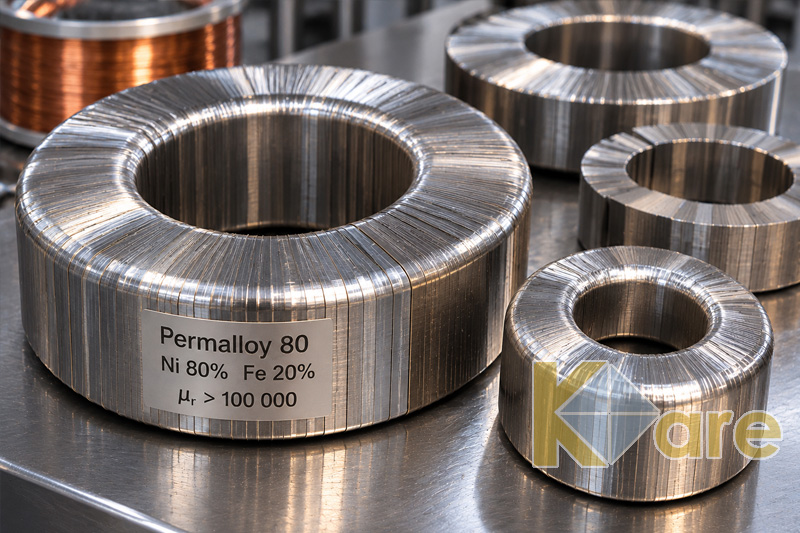
Classic high-nickel permalloy contains approximately 80% nickel and 20% iron. However, the name covers several compositions, including alloys with lower nickel contents and grades containing molybdenum, copper or other additions. The exact chemical composition depends on the specific grade.
Nickel and iron form the ferromagnetic structure of the material. Their relative proportions, alloy purity, rolling conditions and heat treatment significantly affect magnetic performance. Consequently, products with similar chemical compositions can exhibit very different magnetic permeability.
Magnetic properties and types of permalloy
The principal characteristics of permalloy are high magnetic permeability, low coercivity and low magnetisation-reversal losses. These properties are especially important in devices that process weak magnetic signals.
- High-nickel alloys containing approximately 80% Ni — used where very high magnetic permeability and sensitivity to weak fields are required.
- Nickel-iron alloys containing approximately 45–50% Ni — used in magnetic cores and electrical devices requiring a different balance of saturation flux density and permeability.
- Molybdenum-containing variants — including certain high-permeability Ni–Fe–Mo alloys whose magnetic characteristics can be enhanced through specialised processing.
High-nickel permalloy generally has a relatively low saturation magnetic flux density compared with some iron-rich soft magnetic materials. This limits its usefulness at high magnetic flux levels but makes it particularly attractive for weak-field applications.
Magnetic performance depends on frequency, field strength, product thickness, residual stresses and annealing conditions. There is no single permeability value applicable to every permalloy grade.
Manufacturing and industrial applications of permalloy
Permalloy is commonly produced as thin sheets, strips, foils, wire and specialised magnetic cores. Cold rolling followed by controlled annealing is frequently used to obtain the required magnetic characteristics.
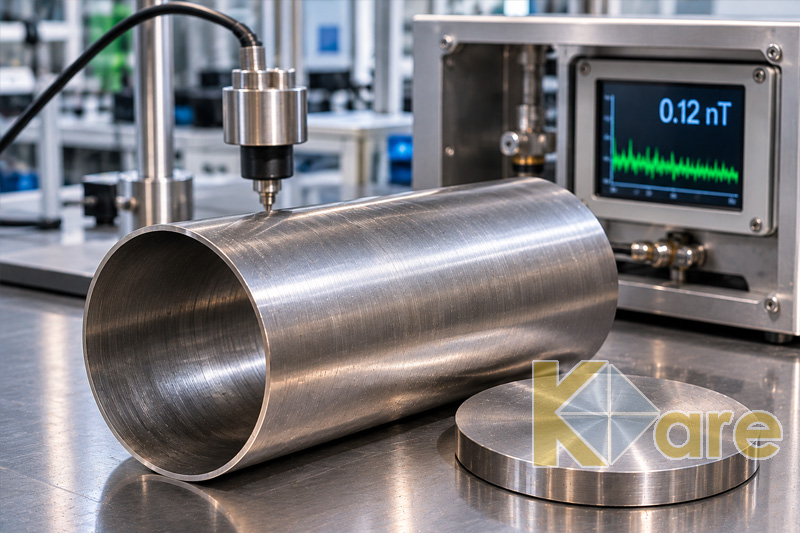
- Magnetic shielding — enclosures and shields that reduce the effects of external static and low-frequency magnetic fields on sensitive equipment.
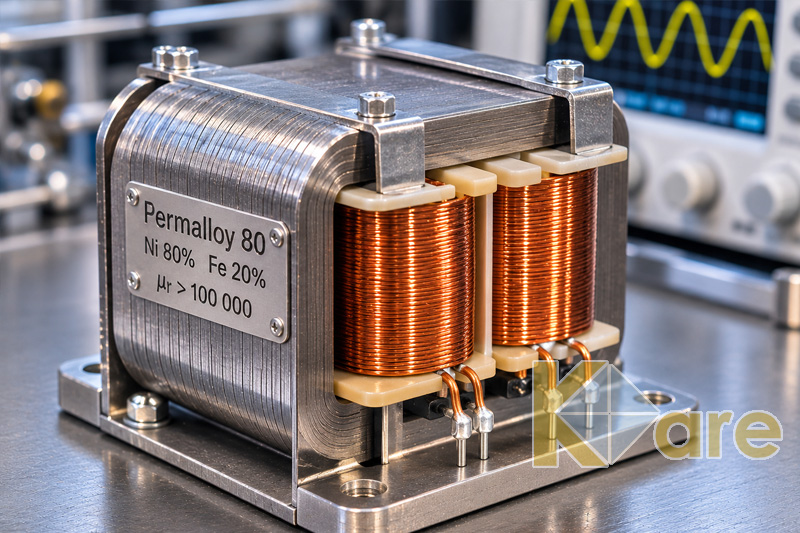
- Transformers and magnetic cores — cores for small-signal transformers, measurement devices and selected electronic components.
- Magnetic field sensors — sensitive elements and magnetic flux concentrators in measurement systems.
- Telecommunications equipment — specialised magnetic components used in signal circuits.
- Scientific and medical instrumentation — magnetic shields and components protecting instruments from external fields.
The effectiveness of magnetic shielding depends not only on the alloy but also on thickness, geometry, gaps, field direction and operating conditions. Shielding for critical instruments must be designed and validated for the intended application.
Standards, heat treatment and material selection
When selecting permalloy, engineers must consider both chemical composition and magnetic characteristics in the specified delivery condition. The IEC 60404-8-6 standard is relevant to certain soft magnetic metallic materials, including nickel-iron alloys.
Magnetic material testing is addressed by the IEC 60404 series. Inspection documents for metallic products may be issued according to EN 10204 when required by the supply specification.
Heat treatment is crucial to magnetic performance. Mechanical deformation, welding or intensive fabrication can introduce stresses that reduce permeability and worsen other magnetic properties. Depending on the grade and application, final annealing in a controlled atmosphere may be necessary.
Material selection should consider initial and maximum permeability, coercivity, saturation flux density, operating frequency, material thickness and temperature. Specific values should be obtained from the manufacturer's technical documentation.
Kare Pluss presents permalloy in the Alloy Atlas as an important family of nickel-iron soft magnetic materials used in electrical engineering, precision measurement and magnetic shielding.