Monel (Ni + Cu) — composition, properties and applications
Monel (Ni + Cu): composition and alloy characteristics
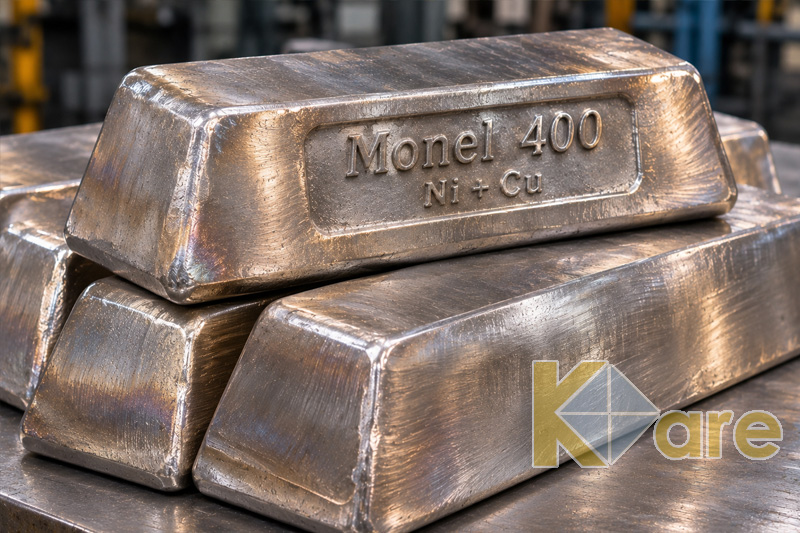
Monel is a family of corrosion-resistant nickel-copper alloys in which nickel is the principal component and copper contributes to a distinctive combination of service properties. Monel is widely associated with marine engineering, chemical processing equipment and industrial machinery.
Common Monel 400 contains at least 63% nickel plus cobalt, with copper typically accounting for 28–34%. Minor constituents may include iron, manganese, silicon and carbon. The formula Ni + Cu identifies the alloy family rather than a single fixed chemical composition.
Monel offers good resistance to seawater, many salt solutions and selected chemical environments. Its actual corrosion performance depends on temperature, chemical concentration, fluid velocity and the presence of oxidising agents.
Monel grades and technical properties
Nickel-copper alloys are supplied in several grades with different compositions, strength levels and manufacturing characteristics.
- Monel 400 (UNS N04400) — a wrought nickel-copper alloy with good ductility and corrosion resistance.
- Monel K-500 (UNS N05500) — a precipitation-hardenable grade containing aluminium and titanium for increased strength.
- Monel R-405 (UNS N04405) — a free-machining grade with increased sulphur content.
Monel 400 has a density of approximately 8.8 g/cm³ and a melting range of roughly 1300–1350 °C. Mechanical properties vary with product form, condition and heat treatment.
Monel can be cold-worked and welded using suitable procedures. Certain grades require specific heat-treatment conditions to develop their intended properties.
Manufacturing and industrial applications of Monel
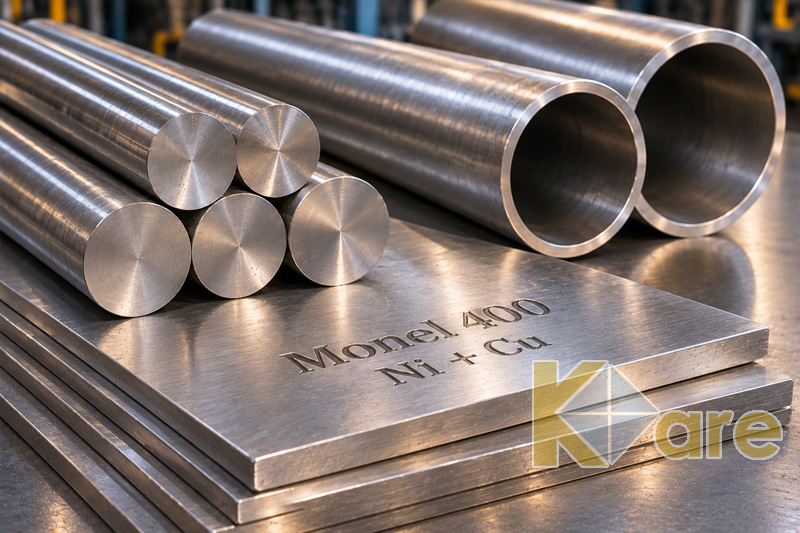
Monel is produced as sheets, plates, bars, tubes, wire, forgings and complex components. It is selected for equipment requiring long service life in corrosive environments.
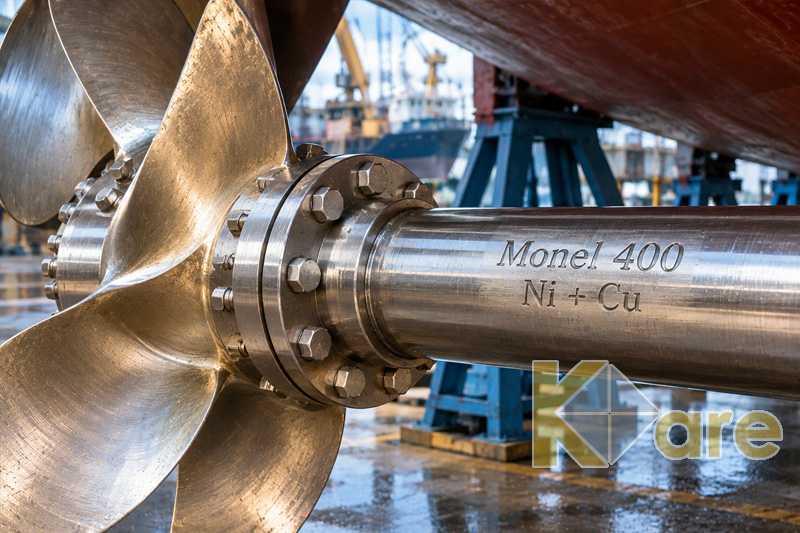
- Marine engineering — shafts, fasteners, pump components and valves.
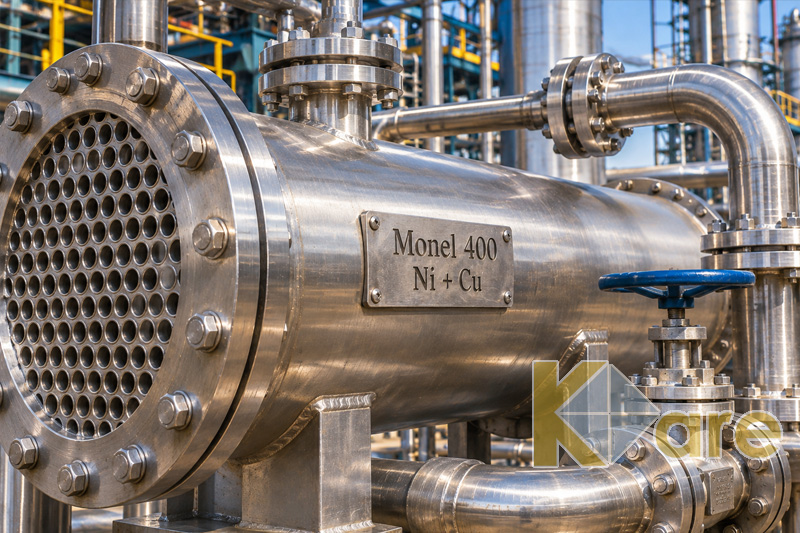
- Chemical processing — piping, heat exchangers, valves and process vessels.
- Oil and gas equipment — selected components exposed to corrosive process media.
- Mechanical engineering — springs, fasteners and critical machine parts.
Grade selection depends on the chemical environment, operating temperature, mechanical loads and manufacturing requirements.
European standards and material selection
Within the European standards system, nickel-copper alloys are covered by relevant nickel and nickel-alloy product specifications. EN 10095 addresses heat-resisting steels and nickel alloys, while EN 10204 specifies types of inspection documents for metallic products. Applicability must be checked for the particular grade and product form.
Monel 400 is identified by UNS N04400 and may be associated with material numbers 2.4360 / 2.4361, depending on the specification. Monel K-500 is designated UNS N05500.
Material selection should be based on verified chemical composition, mechanical properties and the manufacturer's inspection documentation. The Monel name alone does not establish suitability for every corrosive environment.
Kare Pluss presents Monel in the Alloy Atlas as a family of nickel-copper engineering materials for marine equipment, chemical processing and demanding industrial applications.