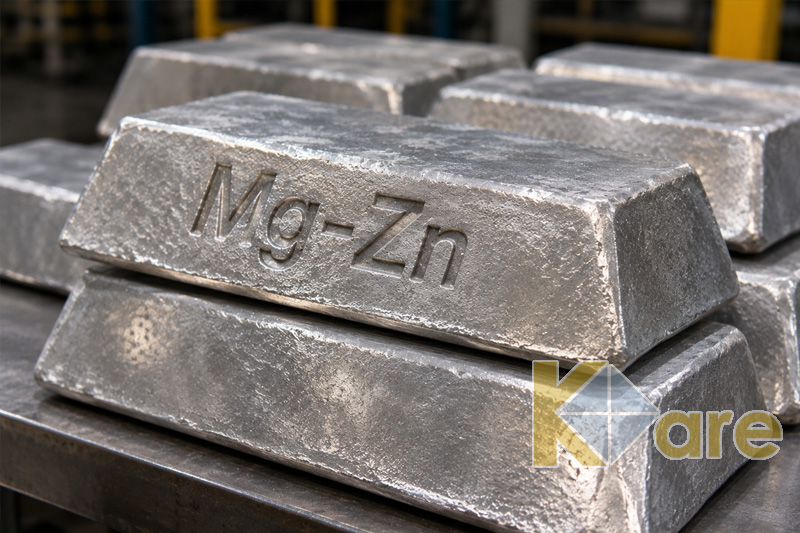
Magnesium-zinc alloys are lightweight metallic materials in which magnesium (Mg) is the base metal and zinc (Zn) acts as an alloying element. Zinc additions can modify strength, microstructure and the material's response to heat treatment.
The Mg–Zn system is relevant to mechanical engineering, lightweight material development and research into biodegradable metallic materials. Industrial applications also use multicomponent magnesium alloys containing zinc, but their properties should not automatically be attributed to the binary Mg–Zn system.
Chemical composition and alloy types
Magnesium forms the metallic matrix. Zinc is partially soluble in magnesium and, under suitable compositions and cooling conditions, contributes to the formation of secondary phases. Zinc content is selected according to the required strength, ductility and manufacturing process.
| Component | Symbol | Function |
|---|---|---|
| Magnesium | Mg | Base metal providing low density |
| Zinc | Zn | Alloying, strengthening and modification of phase composition |
| Additional elements | Various | May occur in multicomponent alloys but are not required in binary Mg–Zn |
Technical and scientific publications often identify binary compositions as Mg–Zn followed by the zinc weight percentage. Such designations do not necessarily correspond to independently standardised commercial alloy grades.
Established magnesium alloy families such as ZK may contain zinc together with zirconium or other elements. They should be distinguished from strictly binary magnesium-zinc compositions.
Microstructure and physical properties
The microstructure of Mg–Zn alloys depends on zinc concentration, cooling rate, deformation and heat treatment. The magnesium-rich matrix may contain zinc-bearing precipitates that contribute to strengthening mechanisms.
- Density: low due to the magnesium base; the precise value depends on zinc content.
- Strength: can increase with suitable alloying and heat treatment.
- Ductility: depends on microstructure, crystallographic texture, grain size and secondary phases.
- Corrosion behaviour: sensitive to composition, impurities, microstructure and service environment.
- Thermal conductivity: depends on the specific composition and material condition.
- Processability: casting, forming and machining are possible subject to appropriate processing limitations.
Zinc does not universally improve every property. Excessive formation of secondary phases can reduce ductility or influence corrosion, so an optimum composition must be established through testing.
Production and processing
Magnesium-zinc alloys are produced by adding zinc to molten magnesium under controlled temperature conditions and protecting the melt against excessive oxidation. The resulting material can be cast and, for suitable compositions, subsequently worked.
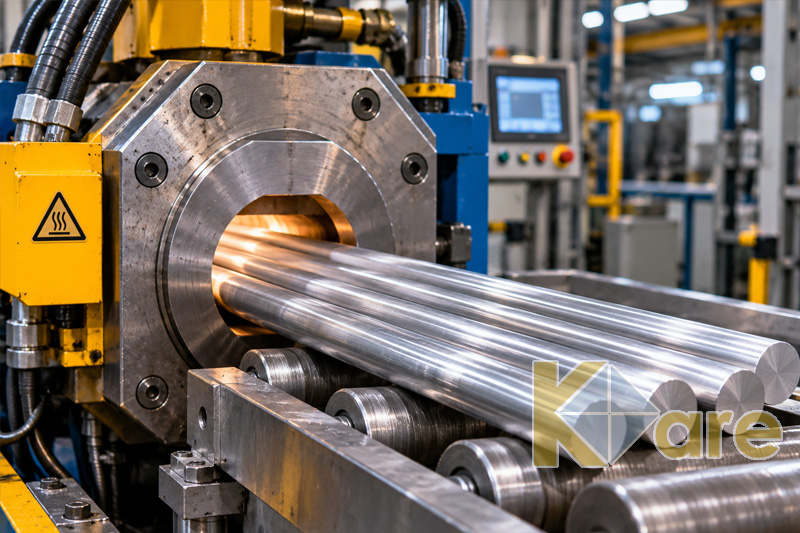
Homogenisation, extrusion, rolling and heat treatment may be used to modify the microstructure. The effectiveness of strengthening depends on alloy composition and processing parameters.
Fire safety is essential: molten magnesium, fine chips and dust require specialised precautions. Combustible metal fires require appropriate Class D extinguishing agents rather than conventional water-based methods.
Fields of application
- Materials science: investigation of magnesium alloying and precipitation-strengthening mechanisms.
- Lightweight structures: development of lower-mass materials for engineering components.
- Mechanical engineering: use of suitable zinc-containing magnesium alloys after verifying required properties.
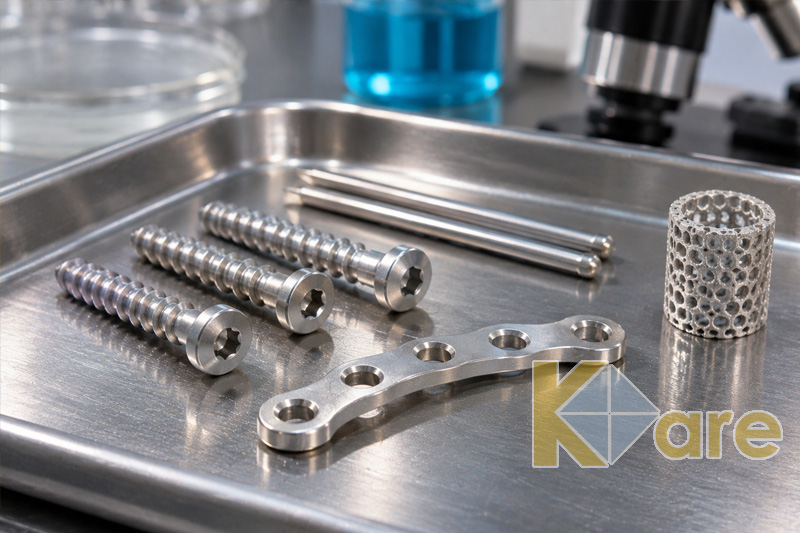
- Medical research: investigation of controlled-degradation magnesium-zinc materials for temporary implants.
- Metallurgy: use of the Mg–Zn system as a basis for developing more complex compositions.
Medical applications require separate evaluation of biocompatibility, corrosion rate, mechanical stability and regulatory compliance. Experimental Mg–Zn materials should not be assumed to have clinical approval.
European standards and requirements
Within the European Union, requirements for magnesium alloys depend on the exact grade, supplied product form and intended application. EN 1753 applies to certain magnesium casting materials, but it should not be treated as a universal specification for every experimental binary Mg–Zn composition.
Industrial applications must consider applicable REACH, CLP, occupational health, fire safety and waste-management requirements.
When a material is developed for a medical device, relevant provisions of Regulation (EU) 2017/745 (MDR) and the necessary safety and performance assessments also apply. The presence of magnesium and zinc alone does not demonstrate suitability for implantation.
Recycling and secondary use
Magnesium-zinc alloys can potentially be recovered through metallurgical recycling. Clean, segregated scrap with a known chemical composition provides the most predictable results.
Before remelting, zinc concentration, impurities and other alloying elements are checked. Mixing unidentified magnesium alloys may compromise the target composition of recycled metal.
Fine magnesium particles, chips and dust require special handling. Storage and recycling operations must account for fire hazards and applicable European environmental requirements.
Advantages and limitations
Advantages: low density of the magnesium base, potential to adjust strength through zinc additions, useful microstructural strengthening mechanisms and opportunities for metallurgical recycling.
Limitations: sensitivity of properties to composition and processing, corrosion concerns, fire hazards associated with fine scrap and limited standardisation of certain binary compositions.
Mg–Zn alloys represent a promising lightweight metal system. Their practical value depends on precise chemical composition, controlled manufacturing and verified properties of the finished product.