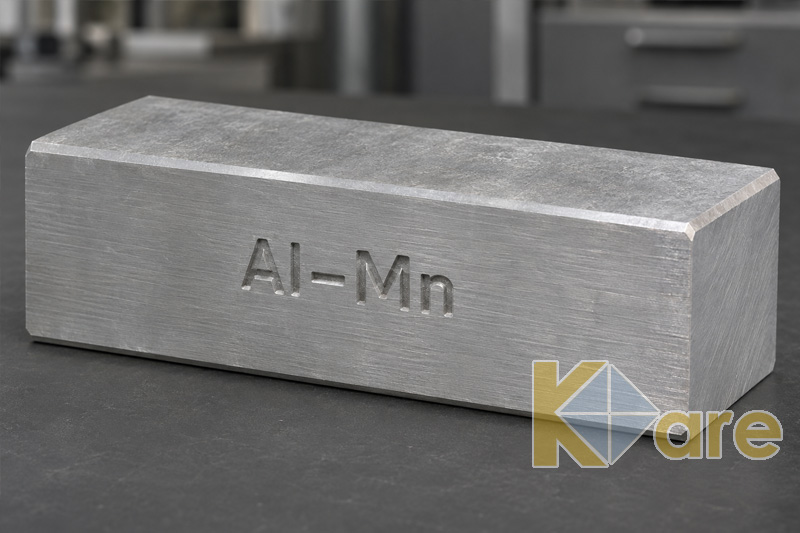
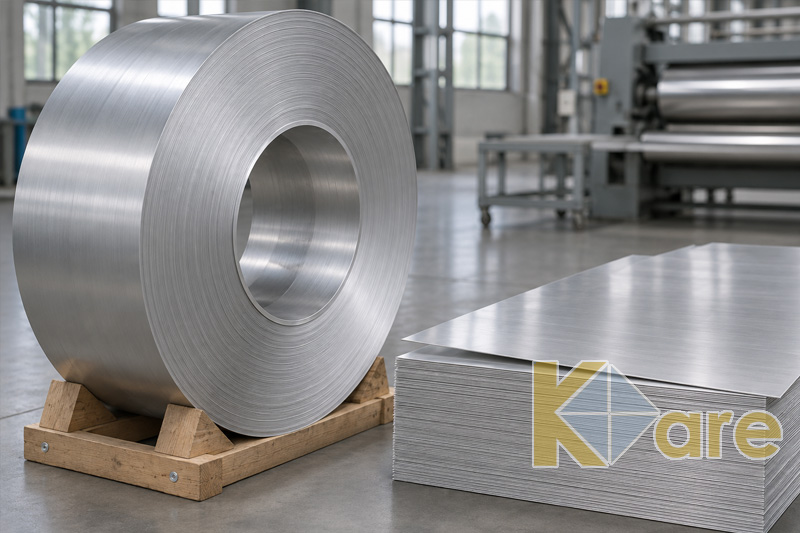
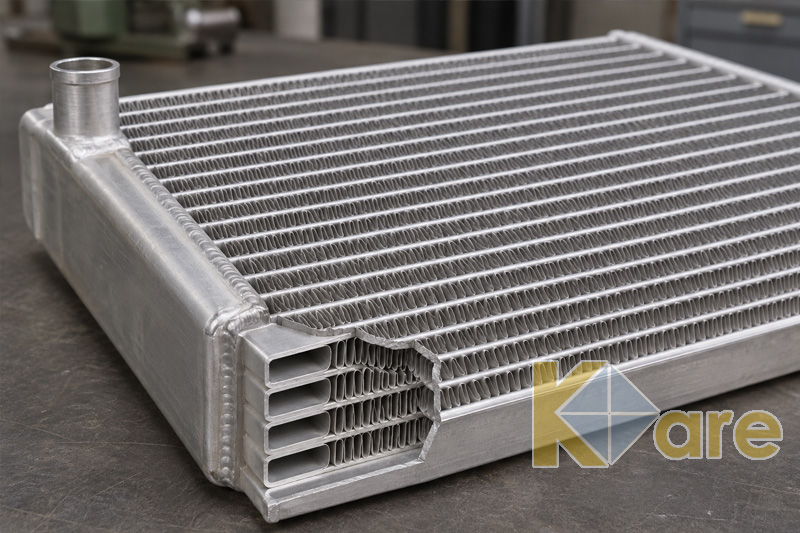
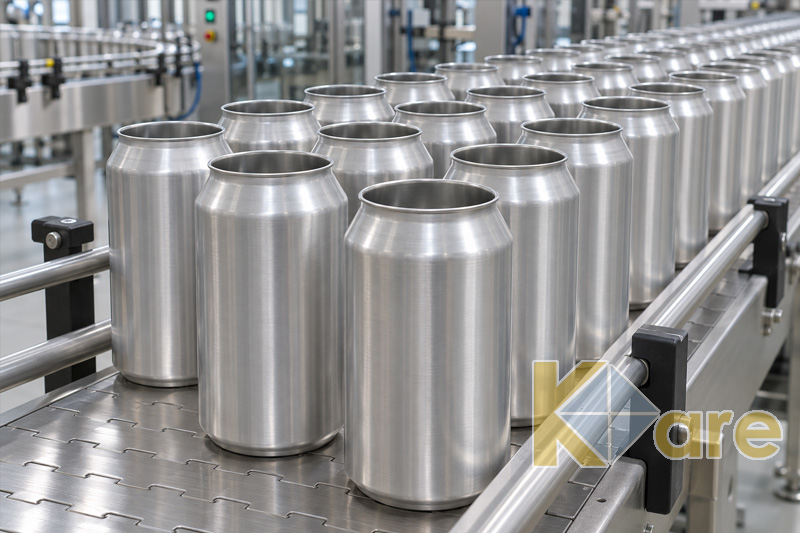
Aluminium-manganese alloys are aluminium-based materials in which manganese is the principal alloying element. They offer low weight, good formability and corrosion resistance. These alloys are widely used to manufacture sheets, strips, heat exchangers, packaging and building products.
What are aluminium-manganese alloys?
Wrought aluminium alloys with manganese as the main alloying element belong to the 3xxx series. Manganese increases strength compared with commercially pure aluminium while retaining a useful combination of ductility and corrosion resistance.
The formula Al + Mn identifies the main components of the group rather than the exact composition of every grade. Depending on the intended application, magnesium, copper and other elements may also be present.
These alloys are particularly useful for products made by rolling followed by sheet-metal processing. They are selected where formability, low weight and resistance to environmental exposure are important.
Chemical composition
| Element | Symbol | Role in the alloy |
|---|---|---|
| Aluminium | Al | Base metal, providing low density |
| Manganese | Mn | Increases strength and influences the material structure |
| Magnesium | Mg | Provides additional strengthening in selected grades |
| Copper | Cu | Present in small amounts in certain grades and influences their properties |
| Iron and silicon | Fe, Si | Contents are limited by the requirements for the individual grade |
Grades 3004 and 3104 contain significant magnesium additions but belong to the 3xxx series. An additional element does not automatically change the classification: the exact composition is checked against the material designation and relevant specification.
Physical and mechanical properties
- Appearance: silvery-grey metal with a surface finish determined by processing.
- Density: close to that of aluminium and dependent on composition.
- Strength: moderate and determined by grade and temper.
- Ductility: highest in the soft, annealed condition.
- Formability: allows the manufacture of bent, stamped and deep-drawn products.
- Thermal conductivity: makes suitable grades useful in heat-transfer equipment.
- Corrosion resistance: good in many atmospheric and service conditions.
- Strengthening: primarily by cold working rather than solution treatment, quenching and ageing.
A single mechanical property value cannot describe the entire group. Results depend on grade, delivery temper, thickness and testing direction.
European grades
| Grade | Composition features | Typical applications |
|---|---|---|
| EN AW-3003 | Al–Mn alloy with a small copper addition | Sheet products, containers and heat-transfer components |
| EN AW-3103 | Aluminium-manganese alloy | Sheets and heat-exchanger components |
| EN AW-3004 | Al–Mn–Mg alloy | Can bodies and formed sheet products |
| EN AW-3104 | Magnesium-containing 3xxx alloy | Strip for beverage can bodies |
EN AW identifies wrought aluminium alloys. Chemical composition is checked against EN 573-3, while temper designations are covered by EN 515. Requirements for sheet, strip and plate are covered by the EN 485 series. The corresponding adopted LVS EN standards apply in Latvia.
Material selection considers the full grade designation, delivery temper and requirements for the particular product form.
Strain hardening and annealing
The 3xxx series does not belong to the heat-treatable alloys strengthened by solution treatment, quenching and subsequent ageing. The main method of increasing strength is cold working, such as cold rolling.
Strain hardening increases strength and hardness while reducing ductility. Annealing reduces the effect of work hardening and restores the material’s ability to undergo forming.
O identifies an annealed temper. H identifies strain-hardened tempers with possible subsequent treatment. The digits following H specify the treatment route and degree of hardening.
Corrosion resistance
A protective oxide film forms on the surface. It provides good resistance in many conditions, although performance depends on the environment, temperature and surface condition.
Chlorides, strongly acidic or alkaline environments, and contact with other metals in damp conditions can affect corrosion behaviour. The complete assembly and service conditions should be assessed for each application.
Painting, lacquering and other coatings can provide additional protection or decorative properties.
Production and processing
Typical supply forms include sheets, strips and coils. The material is used for bending, stamping, deep drawing and roll forming. The permissible degree of deformation depends on the grade, thickness and temper.
Soft tempers are suitable for complex forming operations. More heavily strain-hardened tempers are used where greater strength is required and lower remaining ductility is acceptable.
Welding, brazing and clad materials
Suitable grades can be welded or brazed using an appropriate procedure. Heating can reduce the strength of strain-hardened material in the joint region.
In brazed heat exchangers, a 3xxx alloy may serve as the core of a clad sheet. The outer layer has a different composition and performs a separate processing function.
Applications
- Heat-transfer equipment: components for radiators and other heat exchangers.
- Packaging: can bodies made from specifically selected grades and tempers.
- Construction: cladding, roofing and profiled sheet products.
- Industrial equipment: casings, containers and formed parts.
- Household products: sheet-metal articles requiring good formability and low weight.
Food-contact applications require assessment of the finished product, including its coatings, manufacturing process and intended conditions of use.
Comparison with other aluminium alloys
| Group | Basic composition | Characteristic features |
|---|---|---|
| Commercially pure aluminium, 1xxx series | Al | High ductility and comparatively low strength |
| Aluminium-manganese, 3xxx series | Al + Mn | Good formability and strengthening by cold working |
| Aluminium-magnesium, 5xxx series | Al + Mg | Magnesium as the principal alloying element; properties depend on its content |
| Aluminium-zinc, 7xxx series | Al + Zn, usually with Mg | High strength achievable through precipitation hardening |
Advantages and limitations
The main advantages are low weight, good formability, corrosion resistance and suitability for sheet-metal manufacture. Different delivery tempers allow a balance between strength and ductility.
Limitations include moderate strength compared with high-strength heat-treatable grades, reduced ductility after strain hardening and possible loss of strength during heating.
How a grade is selected
Selection considers the required product shape, drawing depth, bend radii, loads, joining method and environmental exposure. Heat exchangers also require consideration of design and brazing procedures, while packaging requires suitable formability and coating performance.
The final choice is based on the properties of the individual grade and temper rather than the general designation Al + Mn alone.