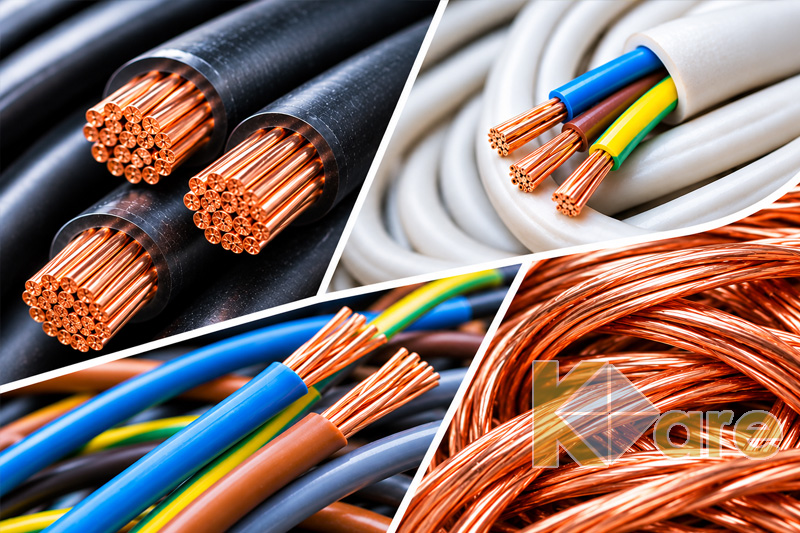
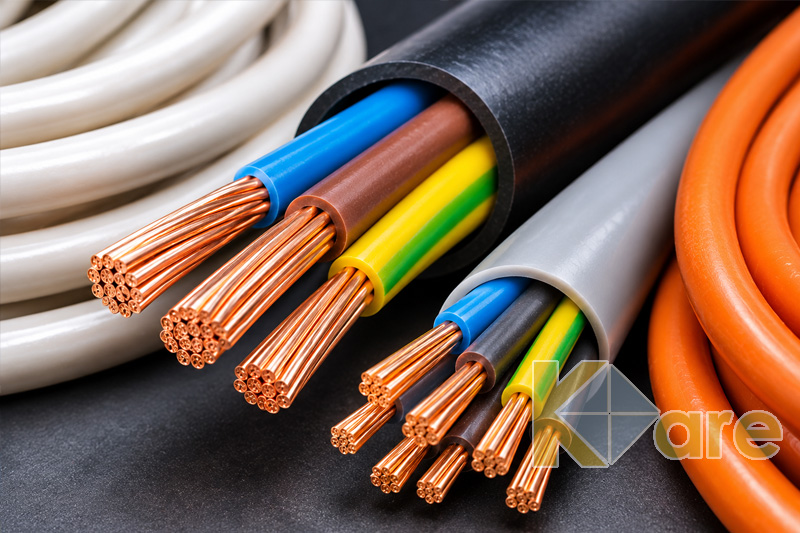
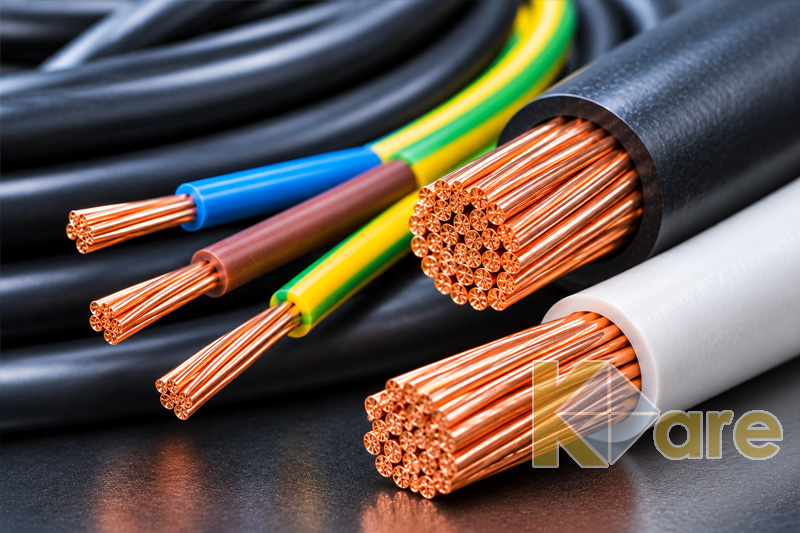
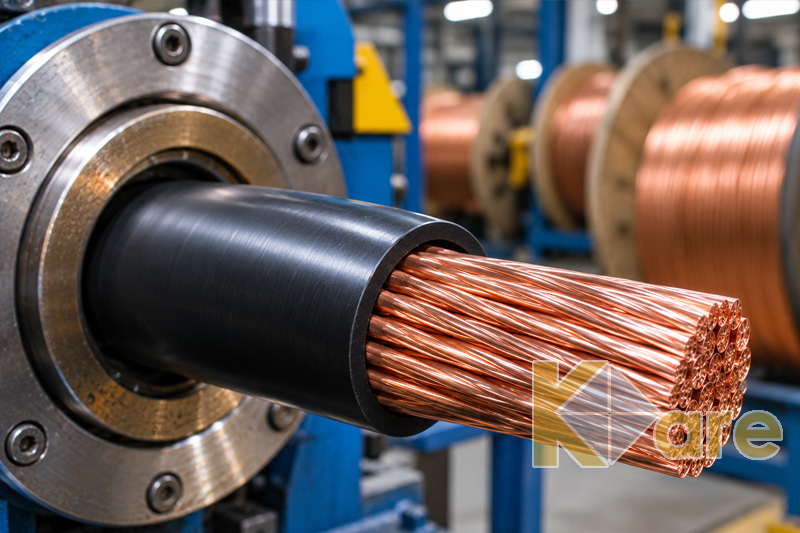
PVC-insulated copper cables are among the most widely used electrical products. Copper (Cu) serves as the conducting material, while polyvinyl chloride (PVC) is used for core insulation and outer cable sheaths.
These cables are used in residential buildings, industry, electrical installations, control systems and household equipment. In cable scrap recycling, the most important factors are cable construction, conductor material and copper content by mass.
Construction of PVC-insulated copper cables
Cable construction depends on its intended application, rated voltage, operating conditions and mechanical strength requirements. The simplest insulated wire consists of a single copper conductor and a layer of PVC insulation. More complex cables contain several insulated cores, an outer sheath and additional protective components.
| Component | Material | Function |
|---|---|---|
| Conductor | Copper, sometimes tinned copper | Transmission of electric current |
| Core insulation | PVC | Electrical insulation |
| Outer sheath | PVC or another polymer | Mechanical protection |
| Filler | Polymeric materials | Maintaining cable shape |
| Screen | Copper, aluminium or combined materials | Protection against electromagnetic interference |
| Armour | Steel or other metals | Additional mechanical protection |
Screens, armour and fillers are not present in every cable. Their presence affects the total cable mass and copper percentage.
Properties of PVC insulation
Polyvinyl chloride is a thermoplastic polymer. Cable insulation is manufactured using specialised PVC compounds containing plasticisers, stabilisers, fillers and other additives.
- Good electrical insulation properties.
- Moisture resistance when supported by suitable cable construction.
- Flexibility depending on the polymer compound.
- Availability of insulation in different colours.
- Relatively low manufacturing costs.
- Many standard PVC cables have a maximum conductor operating temperature of 70 °C, although other temperature ratings exist.
PVC contains chlorine and is not a halogen-free material. Thermal decomposition can produce hazardous and corrosive substances, including hydrogen chloride. PVC cables must therefore be distinguished from cables with halogen-free insulation and sheathing.
Main types of copper cables
Copper cables and insulated wires are classified according to the number of cores, conductor construction, intended application, rated voltage and operating conditions.
| Type | Construction | Typical application |
|---|---|---|
| Single-core installation wires | One insulated copper conductor | Distribution boards and fixed installations |
| Multicore installation cables | Several insulated cores within a common sheath | Building wiring |
| Flexible cables and cords | Flexible stranded conductors | Household appliances, extension leads and equipment |
| Power cables | Conductors designed for electrical power transmission | Building and industrial power supplies |
| Control cables | Multiple cores for control circuits | Automation and industrial equipment |
| Screened cables | Additional metallic screen | Measurement and control systems |
| Armoured cables | Additional metallic armour | Conditions involving increased mechanical stress |
Classification of copper conductors
Under EN IEC 60228, electrical cable conductors are divided into classes describing their construction and electrical characteristics.
| Class | Conductor construction | Characteristics |
|---|---|---|
| 1 | Solid conductor | Rigid conductor for fixed installations |
| 2 | Stranded conductor | Primarily intended for fixed installations |
| 5 | Flexible stranded conductor | Increased flexibility |
| 6 | Extra-flexible stranded conductor | Greater flexibility than class 5 |
The number of cable cores must not be confused with the number of individual wires within each conductor. A single-core wire may have a stranded conductor, while a multicore cable may contain several solid conductors.
Conductor class alone does not determine copper content by mass. Conductor cross-sectional area, insulation thickness, outer sheath and other construction elements must also be considered.
European and international standards
Copper cable manufacturing and testing are governed by various standards. The applicable standard depends on cable type, rated voltage and intended application.
| Standard | Scope |
|---|---|
| EN IEC 60228 | Electrical cable conductors, conductor classes and electrical resistance |
| EN 50525-2-31 | Single-core non-sheathed cables with thermoplastic PVC insulation |
| EN 50525-2-11 | Flexible cables with thermoplastic PVC insulation |
| EN 50525-2-51 | Oil-resistant control cables with thermoplastic PVC insulation |
| EN 50363 | Insulating, sheathing and covering materials for low-voltage cables |
| IEC 60502-1 | Power cables with extruded insulation for rated voltages of 1 and 3 kV |
| EN 50575 | Reaction-to-fire requirements for cables used in construction works |
These standards establish technical requirements for cable products but do not define universal scrap purchasing categories or fixed copper percentages.
Markings of PVC-insulated copper cables
Cable markings identify rated voltage, insulation material, conductor construction and other characteristics. Harmonised designations beginning with the letter H are widely used in Europe.
Understanding harmonised cable markings
| Designation | Meaning |
|---|---|
| H | Harmonised cable type |
| 03 | Rated voltage 300/300 V |
| 05 | Rated voltage 300/500 V |
| 07 | Rated voltage 450/750 V |
| V | PVC insulation or sheath, depending on its position in the designation |
| VV | PVC insulation and PVC sheath |
| V5 | Special oil-resistant PVC compound |
| U | Solid conductor |
| R | Rigid stranded conductor |
| K | Flexible conductor for fixed installations |
| F | Flexible conductor in a flexible cable |
Common copper cable designations
| Designation | Rated voltage | Description |
|---|---|---|
| H05V-K | 300/500 V | Flexible single-core PVC-insulated wire |
| H07V-U | 450/750 V | Single-core wire with a solid conductor |
| H07V-R | 450/750 V | Single-core wire with a rigid stranded conductor |
| H07V-K | 450/750 V | Flexible single-core installation wire |
| H03VV-F | 300/300 V | Light-duty flexible cable with PVC insulation and sheath |
| H05VV-F | 300/500 V | Flexible cable with PVC insulation and sheath |
| H05VV5-F | 300/500 V | Flexible cable with an oil-resistant PVC sheath |
| NYM | 300/500 V | Installation cable with PVC insulation and sheath |
| NYY | 0.6/1 kV | Power cable with PVC insulation and sheath |
NYM and NYY belong to a different designation system commonly used in Germany and several European countries. They cannot be decoded using the rules for harmonised H designations.
Example: decoding H07V-K
- H — harmonised type.
- 07 — rated voltage of 450/750 V.
- V — PVC insulation.
- K — flexible conductor for fixed installations.
Example: decoding H05VV-F 3G2.5
- H05 — harmonised cable rated at 300/500 V.
- VV — PVC core insulation and PVC sheath.
- F — flexible conductor construction.
- 3 — three cores.
- G — includes a green-yellow protective conductor.
- 2.5 — nominal cross-sectional area of each core is 2.5 mm².
The designation 3X2.5 indicates three cores with a cross-sectional area of 2.5 mm² without a green-yellow protective conductor. If the conductor material and cross-sectional areas are identical, the presence of a protective conductor does not change the theoretical total copper mass of the three conductors.
How to distinguish copper cables from aluminium cables
The appearance of PVC insulation alone cannot reliably identify the conductor material. Cables of the same colour and diameter may contain copper, aluminium or copper-clad aluminium.
| Material | Approximate density | Characteristic features |
|---|---|---|
| Copper (Cu) | 8.96 g/cm³ | Reddish metallic colour on a fresh cross-section |
| Tinned copper | Close to copper density | Silvery surface with a copper core |
| Aluminium (Al) | 2.70 g/cm³ | Silvery colour throughout the cross-section |
| Copper-clad aluminium (CCA) | Depends on composition | Outer copper layer and aluminium core |
Preliminary identification involves examining a fresh cross-section, checking mass and inspecting markings. Instrumental analysis may be necessary. A magnetic test alone cannot distinguish copper from aluminium.
How to calculate copper content
Copper content by mass is determined by the ratio of copper mass to total cable mass:
- Cu% — copper content by mass, %;
- mCu — copper mass;
- mtotal — total cable mass.
If 65 kg of clean copper is obtained from 100 kg of cable after separating the remaining materials, the copper content by mass is 65%.
Theoretical mass of copper conductors
When all copper conductors have the same nominal cross-sectional area, the approximate copper mass per metre can be calculated using the following formula:
- mCu — estimated copper mass, g/m;
- n — number of copper cores;
- S — nominal cross-sectional area of one core, mm²;
- 8.96 — factor corresponding to the approximate density of copper in g/cm³.
| Construction | Total cross-sectional area | Estimated copper mass |
|---|---|---|
| 1 × 1.5 mm² | 1.5 mm² | 13.44 g/m |
| 1 × 2.5 mm² | 2.5 mm² | 22.40 g/m |
| 3 × 1.5 mm² | 4.5 mm² | 40.32 g/m |
| 3 × 2.5 mm² | 7.5 mm² | 67.20 g/m |
| 5 × 6 mm² | 30 mm² | 268.80 g/m |
| 4 × 35 mm² | 140 mm² | 1254.40 g/m |
If the conductors have different cross-sectional areas, use the sum of all copper conductor cross-sectional areas instead of multiplying the number of cores by the area of one core.
Practical calculation example
Consider a 3 × 2.5 mm² cable with a hypothetical total mass of 110 g/m. First, calculate the theoretical copper mass:
Next, calculate the copper content by mass:
The figure of 110 g/m is provided solely as a hypothetical example. Nominal cross-sectional area, wire and core stranding, manufacturing tolerances and additional copper components may affect the actual copper mass.
More accurate assessments use manufacturer technical data or the weighing of a representative sample after mechanically separating the insulation and other materials.
Factors affecting copper percentage
- Number and nominal cross-sectional area of copper conductors.
- Thickness of individual core insulation.
- Outer sheath thickness.
- Presence of fillers and separating layers.
- Presence of metallic screens and armour.
- Conductor material.
- Presence of connectors, terminals and foreign materials.
Two cables with identical outer diameters may have significantly different copper contents by mass. An assessment based solely on outer diameter is therefore unreliable.
Applications of PVC-insulated copper cables
- Fixed wiring in residential and commercial buildings.
- Distribution boards and electrical cabinets.
- Power supplies for industrial equipment.
- Connection of household electrical appliances.
- Lighting systems.
- Control circuits and industrial automation.
- Extension leads and connecting cords.
- Cable networks and power installations of suitable design.
When selecting a cable for service, the applicable standard, permissible current load, temperature, installation method and environmental conditions must be considered.
Sorting and valuation of cable scrap
When accepting PVC-insulated copper cables for recycling, the primary economic factor is the quantity of copper that can be recovered. Insulation removal costs, foreign materials and batch uniformity are also considered.
- Separate copper cables from aluminium and CCA cables.
- Sort uniform batches according to construction and estimated copper content.
- Assess armoured and screened cables with regard to their additional materials.
- Account separately for connectors, steel parts and other foreign materials.
- Determine actual copper recovery from a representative sample where necessary.
Purchasing categories and valuation conditions may differ between scrap recycling companies. Cable markings assist product identification but do not replace an assessment of actual material composition.
Recycling PVC-insulated copper cables
Cable scrap recycling aims to separate metallic and polymer components. This is achieved through mechanical stripping, cable shredding and subsequent material separation.
- Stripping — mechanical removal of the sheath and insulation from copper conductors.
- Granulation — shredding cables into small fractions.
- Separation — separating copper, polymers and other components.
- Cleaning — removing residual contaminants from the metallic fraction.
- Further processing — sending recovered copper and polymer materials to appropriate recycling facilities.
Open burning of PVC insulation must be avoided because it produces hazardous combustion products, pollutes the environment and can reduce the quality of recovered copper.
PVC-insulated copper cables are a valuable source of secondary copper. Understanding their construction, markings and methods of determining metal content enables accurate product identification, material sorting and objective assessment of their suitability for recycling.