Titanium (Ti) — Properties and Uses
Titanium — a metal for lightweight, corrosion-resistant structures
Titanium (Ti) is a chemical element with atomic number 22, belonging to group 4 of the periodic table. It is a silvery-grey transition metal combining relatively low density, a high melting point and resistance to corrosion in many environments.
Commercially pure titanium and titanium alloys are used in chemical processing equipment, aerospace engineering, marine systems and medicine. Their properties differ: the high strength of a particular alloy should not automatically be attributed to the pure element.
Key characteristics of titanium
Physical properties
Titanium is considerably lighter than iron and steel but denser than aluminium. Commercially pure metal has good ductility, while its strength depends partly on oxygen and other impurity contents. Its thermal conductivity is substantially lower than that of copper and aluminium.
Under normal conditions, titanium has a hexagonal crystal structure known as the α phase. At approximately 882 °C, pure titanium transforms into the body-centred cubic β phase. Alloying elements alter phase stability and transformation temperatures.
Chemical properties and corrosion resistance
A thin protective oxide film rapidly forms on titanium exposed to air. This passivation provides resistance in many aqueous environments, including seawater. If damaged, the film can reform under conditions that support passivation.
Titanium does not resist every environment: certain acids, fluoride-containing solutions and particular operating conditions can cause corrosion. At high temperatures, the metal reacts readily with gases, so melting and welding require appropriate protection.
Titanium in nature and its production
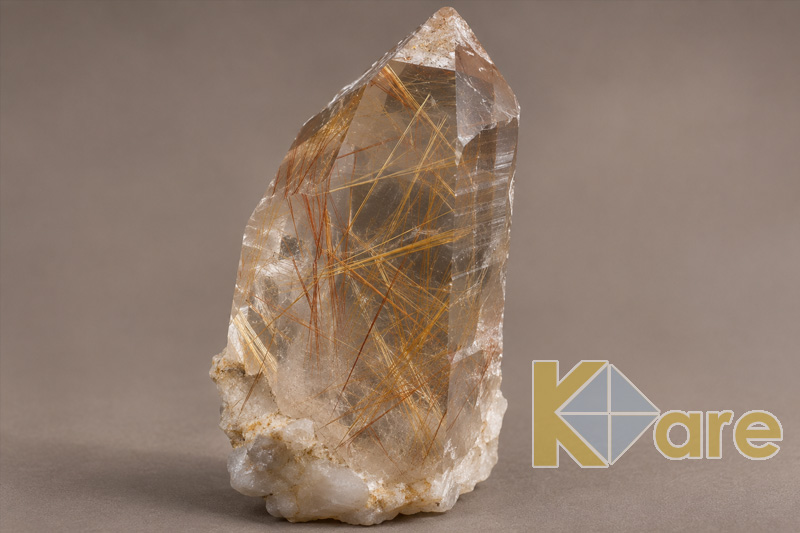
In nature, titanium occurs mainly in compounds. Its most important industrial minerals include ilmenite, FeTiO₃, and rutile, TiO₂. Natural rutile is titanium oxide rather than a crystal of metallic titanium.
A major industrial production route is the Kroll process, in which purified titanium tetrachloride is reduced with magnesium in a controlled environment. The resulting titanium sponge is purified and subsequently remelted into ingots.
Where titanium is used
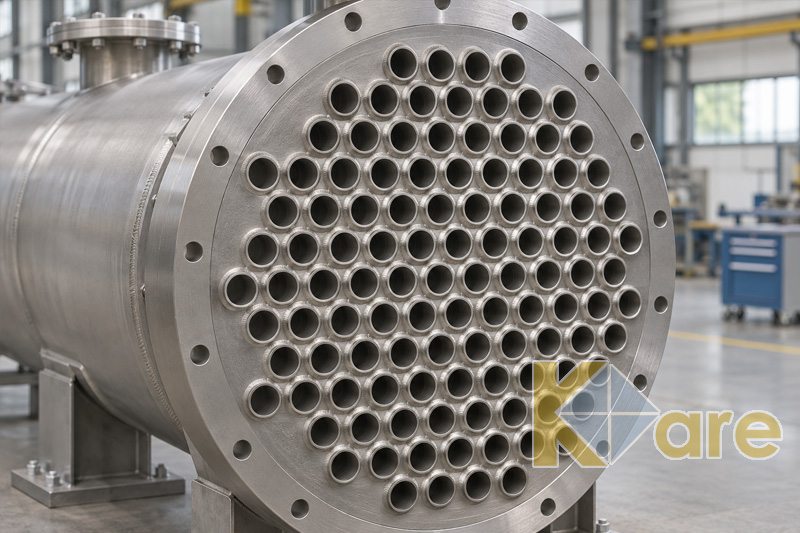
Chemical processing equipment
Heat exchangers, pipes, vessels and equipment components made from suitable titanium grades for corrosive environments.
Marine systems
Components for seawater circuits, desalination equipment and heat exchange systems where corrosion resistance is important.
Medical devices
Commercially pure titanium and specifically designated alloys are used in implants and other devices because of their combination of corrosion resistance and biocompatibility.
Aerospace engineering
Mainly specialised titanium alloys for loaded components, fasteners and aircraft engine parts within their permitted operating temperature ranges.
Titanium and its alloys
Commercially pure titanium is selected primarily for its combination of corrosion resistance and formability. Alloying with aluminium, vanadium, molybdenum and other elements increases strength and provides other required characteristics.
One well-known alloy is Ti–6Al–4V, containing approximately 6% aluminium and 4% vanadium by mass. Titanium alloys are classified as α, α+β or β according to their microstructure. Selection depends on strength, processing and service requirements.
Titanium and its compounds
Metallic titanium and titanium dioxide, TiO₂, have different properties and applications. Titanium dioxide is widely used as a white pigment in paints, plastics and other industrial products. The white colour of TiO₂ is not the colour of the metal itself.
Another technically important material is titanium nitride, TiN. It is used in hard, wear-resistant coatings that often have a golden appearance. These coatings should also be distinguished from pure titanium and bulk titanium alloys.